

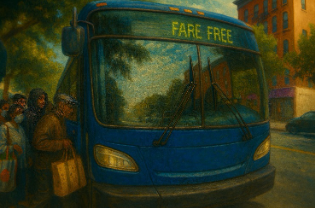
Among residents of New York City, and among public transportation experts throughout the country, no one can stop talking about free buses. I have been writing about changes in bus structures and accommodations (see https://transalt.com/article/survival-and-prosperity-part-2-the-magic-coach/ ), fare structures (see https://transalt.com/article/low-income-certification-why-not-motorcoaches/ and https://transalt.com/article/congestion-pricing-how-it-can-make-sense/ ), controlling cars (see https://transalt.com/article/controlling-cars-the-last-frontier-of-public-transportation/), increased usage of motorcoaches in transit service (see https://transalt.com/article/new-opportunities-for-increased-motorcoach-usage-in-transit-service/ ), danger signs ahead in the transit and motorcoach sectors (see https://transalt.com/article/danger-signs-ahead-for-u-s-transit-and-motorcoach-sectors-part-1/ and https://transalt.com/article/danger-signs-ahead-for-u-s-transit-and-motorcoach-sectors-part-2/ ) , fare evasion (see https://transalt.com/article/crime-does-not-always-pay/, and even the effects of transit on climate change https://transalt.com/article/motorcoaches-and-climate-change/) regularly for more than 25 years now, off and on for transportation magazines such as National Bus Trader and School Transportation News. Yet when it was apparent that Zohran Mamdani was about to become New York City’s next mayor, and free buses were one of his thoughtless responses to the bus systems rate of fare evasion – 48 percent of bus riders did not pay the fares – I began focusing more closely on the variables. Among the most important points were:
- To address fare evasion, a month’s work by a few hundred police officers, with first offenses being 3 days in the local jail without one’s phone (but much longer sentences for those committing this crime as a second offense) would likely put a stop to it quickly.
- While $2.90/ride was certainly burdensome for many of the City’s poor (and even worse for its homeless), the City could provide deeply discounted rides for most of them (see https://transalt.com/article/congestion-pricing-how-it-can-make-sense/ and make up for it by adding small First Class compartments in the front of the bus for which those passengers who could afford it would pay significantly higher fares in return for superior amenities — just as they do on commercial airlines and on passenger trains throughout Europe (see https://transalt.com/article/survival-and-prosperity-part-2-the-magic-coach/).
- Early statistics on the safety of driverless vehicles in the U.S. – openly available from Waymo – suggest that driverless buses and coaches would be much safer, and obviously less costly, since drivers and fringe benefits would be eliminated, along with the disappearance of factors like fatigue.
An odd factor on this topic about which almost no one speaks or writes is the fact that free buses make sense in some cities far more than others. While such thoughts are more opinionated than most others, it clearly seems backwards to offer free bus service in the city where fares cover the highest percentage of operating costs in the nation, as does New York City – although to be fair about this factor, that high “operating ratio” largely reflects the high ridership and far greater productivity on that city’s subways than on its buses – although a fare evasion rate of 48 percent on buses skews these figures a bit.
Just the same, it did not appear nearly as controversial when Kansas City eliminated bus fares in 2020, when bus fares covered only about six percent of the system’s operating costs, and it would likely have cost more to collect, enforce and process these fare payments than these fares covered. Yet this approach did not even work in Kansas City, mostly because the additional funds to keep them on the road were not available. And here, only an additional $10M would have sufficed.
But what about Los Angeles County – when in 2018 (two years before COVID-19 struck), fares covered a mere 8.5 percent of the transit system’s operating costs – and these figures included subway ridership? The point is, how much longer can we expect the taxpayers in many cities to even consider such measures?
In making this last statement, our nation’s polarization cannot be ignored. If President Trump will soon eliminate the SNAP program – which pays for basic food for about an eighth of the nation’s population, and many other things that used to cost money are now largely free (like music), whereas other services (like television) have been charging fees for roughly 40 years now (unless one chose to listen to and watch only a handful of basic stations by using “rabbit ears” and a rooftop antenna) – free bus transportation hardly makes sense, at least politically.
U.S. citizens will watch closely when this experiment begins in New York City. Most important is the question of to what degree other cities around the country will adopt such measures and programs. I cannot help thinking that cities like Portland OR will adopt measures like low income certification long before cities like Montgomery, AL will provide bus service for free. The nuances of such “bets” hardly need much exploration.
The problem is that none of these approaches will save transit. As a starting point that I learned as an expert witness having done roughly 700 public transportation cases since 1989, half of all the buses, coaches, vans and minibuses and everything else I examined ran behind schedule. And most of these schedules were too tight – making both the buses’ arrivals and drop-offs unpredictable. Also compromised were trips where passengers had to transfer from one bus to another; missing one’s transfer meant waiting often a great deal for the next one to arrive. On routes with headways an hour apart, missing a transfer could jeopardize more than just arriving to school or work on time. It could mean missing a dialysis appointment. Missing a few of these usually meant dying. So buses that don’t run on schedule is a serious deterrent that few transit agencies even make an effort to solve.
It is also important to note that my 50 percent of the mix of vehicles I’m involved in as a forensic expert also includes many whose schedules are not tight. Few general education or special education schoolbuses are late. Few limousines are late. Few motor coaches are late. When AMTRAK trains are late, they have enough slack in the schedules to catch up. And the concept doesn’t exist for taxicabs. When you consider what modes are left, one is limited to fixed route transit, paratransit and non-emergency medical service. From my experience, almost every one of these vehicles is late, wherever they go. In major cities like New York, Chicago, Los Angeles, Houston, or buses deployed by New Jersey Transit, I have often ridden and timed them – scores of them – since late schedules induce drivers to commit “safety compromises” (see safetycompromises.com). In some cities, like Chicago, most of the routes’ schedules literally dissolve in the early afternoon: The buses just “come when they come.” In roughly 150 wheelchair tipover cases I’ve served as an expert on, mostly involving wheelchair tipovers, I have yet to find a single such incident where the vehicle was not running behind schedule. Non-emergency medical transportation (NEMT) service is even more work than complementary paratransit service because at least paratransit service (almost always contracted out) is at least directed by a transit agency. In NEMT service, not only is service ultimately controlled by a healthcare agency. But virtually every healthcare agency in the country has engaged an interim layer of brokers to then direct the litany of contractors they select. Most of these brokers are completely ignorant about this form of service. The two largest – which operate in all or part of 45 states and the District of Columbia – are outright crooked. But while it is their formal responsibility to direct the service of their contractors – usually including training and monitoring them, such tasks are rarely performed. Arriving late to one’s dialysis appointment is almost routine.
The point is that several modes of transportation in the United States provide horrible service. Because fixed route buses are the “backbone” of these services (I am not implying that travelers on other modes often transfer to or from fixed route service, which almost never happens), the abysmal quality of these services has become a major, unsolvable problem to most of our major cities. And it will only get worse.
#freebuses #publictransitexpert #transalt #transittrends #urbanmistakes