

The Wrong Place at the Wrong Time: Lack of Guidance in Congestion Pricing

In previous posts, and one my last-and-final articles in National Bus Trader magazine (see https://transalt.com/article/low-income-certification-why-not-motorcoaches/), I discussed low-income certification as a moderate and reasonable compromise between free buses and the forty eight percent of New York City’s bus riders who evade paying fares altogether. And in several articles and posts I argued that the notion […]
Parking Structures – Path to the Future

Two days in New York City last week made the transportation game plan for the future – in NYC and elsewhere – more clear. While traffic levels were exaggerated on Thanksgiving Eve day and Thanksgiving itself, it is clear that apart from the collapse of transit, the solutions proposed to solve other issues are sorely […]
Especially for Lawyers – Why So Many Wheelchair Tipovers, Part 16

One factor that affects securement is track or oval orientation – longitudinal or lateral. If the distance between tracks is too close together – in violation of the requirements for longitudinal length found at 49 C.F.R. § 38.23(d)(2) – then few or no wheelchairs can be secured in that shorter space. This is because the devices to secure the front and rear of the chairs cannot be made shorter than 13 ½ inches – leaving only 21 inches for the distance between securement points on the wheelchair. They are rarely much closer together. So, for example, if the tracks are only 40 inches apart, the vehicle’s purchaser likely saved money in buying a smaller vehicle. But no wheelchair on the planet can be secured in such a small space.
#wheelchairtipovers #wheelchairandpassengersecurement #transalt #accessiblevehicles #wheelchairtransportation
Read full post at TransAlt.com
Especially for Lawyers – Why So Many Wheelchair Tipovers, Part 15
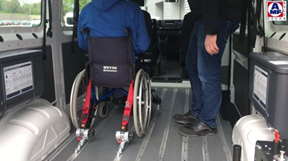
The positioning of wheelchairs in certain modes – against the wall instead of in the center of the vehicle – accounts for the low level of securement on those modes. This pattern is largely the result of the difficulty of drivers reaching ground-level securement equipment located on the wall side of the wheelchair – forcing drivers to effectively kneel down (often hurting their knees), crawl around, and effectively grovel at the feet of individuals whom many consider inferior by virtue of the fact that they cannot walk.
#wheelchairtipovers #wheelchairandpassengersecurement #transalt #wheelchairpositioning
Read full post at TransAlt.com
Especially for Lawyers – Why So Many Wheelchair Tipovers, Part 14

There are many, many reasons why wheelchairs are either rarely secured on certain modes and services or never secured on them. The only mode that reliably secures wheelchairs is a schoolbus – both on a large bus or a smaller van- or minibus-conversion. Whenever they are not secured, there is never a valid reason for this, and this failure is almost always a violation of the ADA, and the lawsuit dealing with this individual’s death or injury – or even the inability to use a restroom – is automatically a violation of that individual’s civil rights. In 1955, when Rosa Parks refused to sit at the rear of the bus, if she did, at least her seat would have been bolted to the floor.
#wheelchairtipovers #wheelchairandpassengersecurement #civilrightsviolations #transalt #safetycompromises
Read full post at TransAlt.com
Especially for Lawyers, Part 13 – Why So Many Wheelchair Tipovers?

In the initial days of wheelchair transportation, a major problem was that the securement points were not far enough apart to accommodate some of the longer chairs. Those days of canvas straps getting caught within their ratchets progressed to the modern system where thin straps wind around a spool found inside a housing – leaving room for two or more feet of strap to be pulled out from any operable housing, with a far lesser chance of them getting caught (and needing repair). Instead, a growing problem with the modern equipment used almost entirely today is that, while the devices can be lengthened by several feet (simply by pulling out more of any housing’s strap), the combination floor fitting, housing and J-hook is now typically (if not mostly) 13 ½ inches long. So the problem has become the fact that these devices cannot be made SHORTER. As a result, it is difficult or impossible to secure a wheelchair within the ADA-required 48-inch minimum longitudinal space for it if the chair’s securement points are fewer than 21 inches apart – since the 13 ½-inch-long securement device at each end leaves only 21 inches of room to place the chair where it can be secured
#wheelchairandpassengersecurement #wheelchairtipovers #wheelchairtranpsortation #transalt #publictransitexpert
Read full post at TransAlt.com
Especially for Lawyers: Why So Many Wheelchair Tipovers, Part 3

The number of wheelchair tipovers that occur each day in this country is startling. But for various reasons, the vast majority of them are not recorded.
#wheelchairtipovers #wheelchairandpassengersecurement #publictransitexpert #transalt
Read full post at TransAlt.com
Especially for Lawyers: Why So Many Wheelchair Tipovers, Part 12 – ADA Tic-Tac-Toe

There are a lot of contradictions in many Federal transportation regulations, the ADA among them. Some are so different that they literally invite lawsuits. And different entities or constituents in the field favor different provisions over others: Regulatory agencies generally prefers them to be weak and fuzzy, while passengers and their advocates would generally prefer them to be more stringent and less ambiguous. With the latter, there would certain be fewer lawsuits. But depending on which political parties wield the most power, the tightness or looseness of regulations swing back and forth from administration to administration. I personally expect this pendulum to swing back and forth in the foreseeable future. Unfortunately, a lot money and a lot of mayhem, echo these swings. But as long as many see various positions as having more or less freedom, I do not expect much change.
#americanswithdisabilitiesact #publictransportationregulations #transalt #adacompliance #wheelchairsecurement #passengersecurement
Read full post at TransAlt.com
Especially for Lawyers – Why So Many Wheelchair Tipovers, Part 11: FTA Regulations and the Cub Scout Handbook.

Adding to the possibly unending list of variables about wheelchair tipovers – the second most-common incident scenario in public transportation in most of its sectors – is a common response by drivers after some wheelchair user spills out of his or her chair – a scenarios that CAN NOT POSSIBLY HAPPEN if the chair’s occupant […]
Especially for Lawyers – Why so Many Turning Incidents

A handful of errors and omissions account for a large number of turning incidents. An attorney is well advised to be aware of them and examine such incidents from these multiple angles.
#turningaccidents #intersectionaccidents #publictransitexpert #transalt #intersectioncollisions
Read full post at TransAlt.com